As your due date gets closer, you may hear your midwife or doctor mention something called a membrane sweep. If you are pregnant in Vienna, you may also hear it referred to as an Eipollösung, Eipolablösung or Zervix-Stripping.
For some women, the suggestion comes as a surprise. You may have been expecting to wait for labour to begin on its own, and suddenly you are being asked whether you would like to have an examination that could potentially encourage labour to start.
So, what exactly is a membrane sweep? Does it hurt? How soon does labour start afterwards? What is normal after the procedure, and when should you contact your midwife or maternity unit?
A membrane sweep is a relatively simple procedure, but it is still completely reasonable to have questions before deciding whether it is right for you.
What is a membrane sweep?
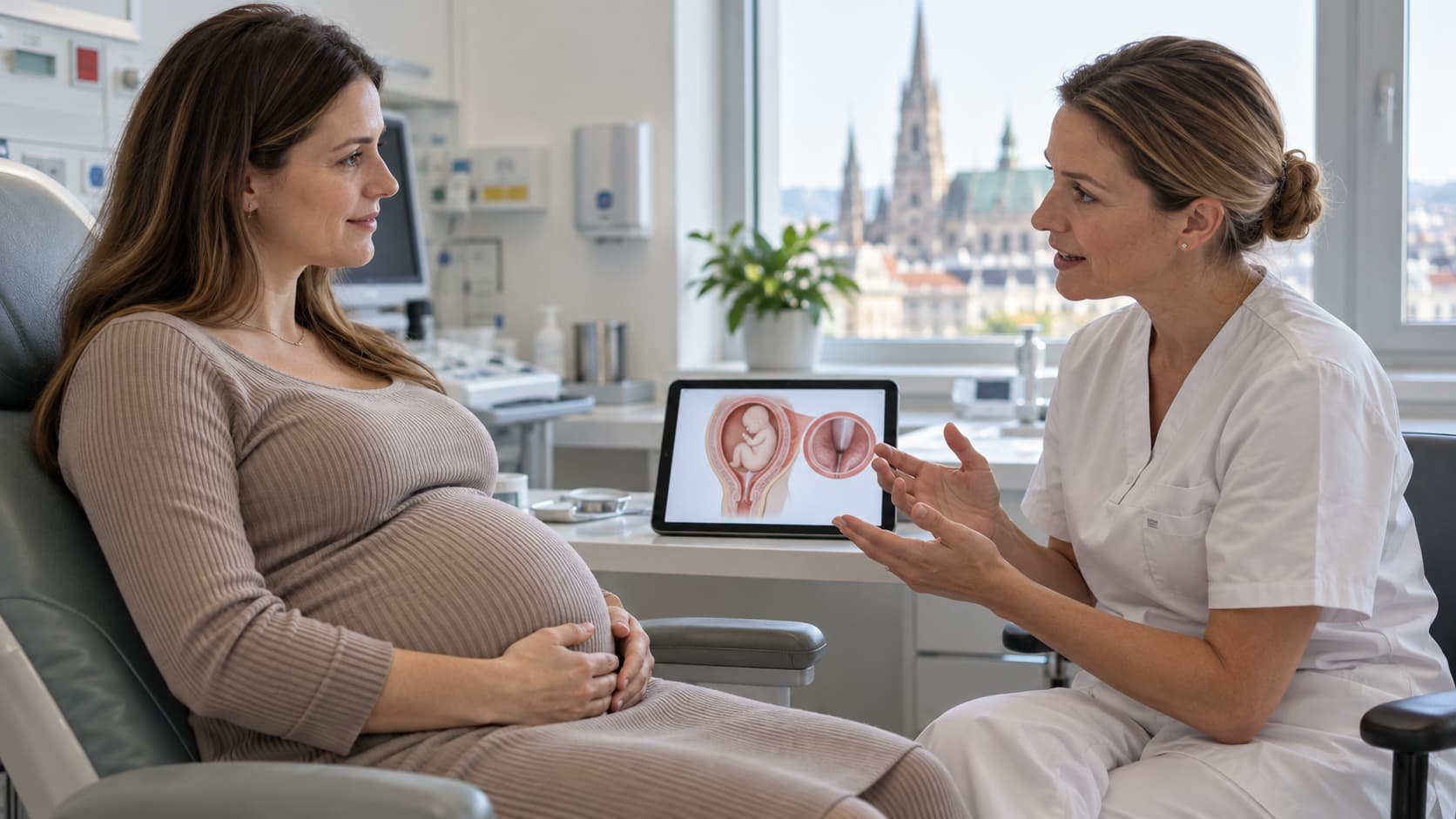
A membrane sweep is a mechanical method that may be used near the end of pregnancy to encourage labour to begin.
During the procedure, a midwife or doctor performs a vaginal examination and gently places a finger through the cervix, if the cervix is open enough to allow this. They then make a circular sweeping movement around the inside of the cervix to separate the lower part of the membranes surrounding the baby from the lower part of the uterus.
In Austria, this procedure is commonly referred to as an Eipollösung or Eipolablösung. You may also hear the term Zervix-Stripping.
The idea behind the procedure is that separating the membranes may encourage the release of naturally occurring prostaglandins. These hormones can help the cervix soften and may encourage contractions to begin.
A membrane sweep is different from a formal medical induction of labour. No induction medication is inserted and the waters are not intentionally broken during a membrane sweep.
The Austrian Health Portal explains that when labour needs to be induced, several medical methods can be considered, including prostaglandins, oxytocin, a balloon catheter and amniotomy. The choice depends on the individual pregnancy and the condition of the cervix.
Why might you be offered a membrane sweep?
A membrane sweep is generally considered when you are approaching or have passed your due date, although exactly when it is offered can vary depending on your pregnancy, your care provider and the maternity unit where you plan to give birth.
In Austria, the clinical guideline from the German, Austrian and Swiss obstetric societies states that an Eipollösung can be offered at term. It is considered one of the mechanical methods that may be used to encourage labour.
Your doctor or midwife may discuss it with you if:
You are approaching or have passed your due date
Your cervix has started to soften or open
There is a reason to discuss getting labour started
You would like to try a less intervention-heavy option before a formal induction
Your maternity team believes it may be appropriate for your individual situation
It is important to remember that there is no universal rule saying every pregnant woman should have a membrane sweep at a particular week.
The timing can depend on your health, your baby's wellbeing, your previous birth history, the condition of your cervix and your plans for birth.
Does a membrane sweep induce labour?
This is where things become a little more complicated.
A membrane sweep can increase the likelihood that labour will start spontaneously, but it does not guarantee that you will go into labour.
The Cochrane review of membrane sweeping included 44 studies involving almost 7,000 women. It found that membrane sweeping may make spontaneous labour more likely and may reduce the likelihood of needing a formal induction. However, the researchers also noted that the overall certainty of the evidence was low and that there is still uncertainty about the ideal timing and number of sweeps.
That means it is best to think of a membrane sweep as an option that may encourage your body towards labour, rather than a procedure that switches labour on.
Sometimes labour begins within a day or two. Sometimes it takes longer. Sometimes nothing noticeable happens at all.
And that does not necessarily mean anything is wrong.
What happens during a membrane sweep?
Before the procedure, your midwife or doctor should explain what they are proposing and give you an opportunity to ask questions.
You can ask:
Why are you recommending a membrane sweep for me?
How many weeks pregnant am I?
Is my cervix suitable for a sweep?
What are the benefits and possible downsides?
What happens if I decide not to have it?
What would the next step be if labour does not begin?
Can I stop the examination at any point?
You will normally lie down or adopt a position that allows your healthcare professional to perform a vaginal examination.
They will first assess the cervix. If it is accessible, a gloved finger may be passed through the cervix and used to make a sweeping movement around the lower part of the membranes.
The procedure itself is usually quite short.
For some women, it feels similar to an uncomfortable internal examination. For others, it can feel quite painful, particularly if the cervix is sensitive or difficult to reach.
You are allowed to say that you are uncomfortable. You can also ask the healthcare professional to stop.
A membrane sweep should not be something you feel pressured into simply because you are close to your due date.
Does a membrane sweep hurt?
There is no single answer because everyone's experience is different.
Some women describe a membrane sweep as uncomfortable pressure. Others experience cramping or pain during the examination.
The Austrian and German obstetric guidance specifically recognises pain during the procedure and vaginal bleeding afterwards as possible side effects.
If you are worried about discomfort, tell your midwife or doctor before the examination. They can explain what they are doing and help you understand what sensations to expect.
It can also help to remember that you remain in control of the examination. You can ask questions, request a pause or ask for the procedure to stop.
What happens after a membrane sweep?

The hours after a membrane sweep can be a little confusing because your body may respond in several different ways.
You might notice:
Mild cramping
Period-like discomfort
Irregular contractions
Increased vaginal discharge
A mucus-like discharge
A "show"
Light spotting or blood-stained mucus
No noticeable change at all
Some women go into labour relatively soon afterwards. Others have a few hours or days of cramping before labour becomes established.
It is also possible to have a membrane sweep and then continue your pregnancy normally for several more days.
The important thing is not to interpret every cramp as the beginning of active labour.
Your body may simply be responding to the examination.
What is a "show" after a membrane sweep?
A show is a mixture of mucus and sometimes a small amount of blood that comes away from the cervix.
You may notice pink, brownish or slightly blood-stained mucus after a membrane sweep.
This can happen because the cervix has been examined and manipulated. It can also happen as the cervix begins to change in preparation for labour.
A small amount of spotting can therefore be normal after a sweep.
However, bleeding that is heavy, increasing or more like a menstrual bleed should not simply be assumed to be a normal result of the procedure.
If you are unsure about bleeding, contact your midwife, doctor or the maternity unit where you plan to give birth.
How long after a membrane sweep does labour start?
This is one of the most common questions, and unfortunately there is no reliable countdown.
Some women begin experiencing contractions within hours. Others go into labour over the following couple of days. Some do not go into labour as a result of the sweep at all.
Research suggests that membrane sweeping can increase the chance of spontaneous labour, but the evidence does not allow anyone to predict exactly when labour will begin for an individual woman.
Your cervix matters too.
A sweep may be easier to perform when the cervix is already beginning to soften, shorten or open. If the cervix is still high, firm and closed, it may not be possible to perform a full sweep.
This is one reason why one woman's experience can be completely different from another's.
Can you have more than one membrane sweep?
Sometimes, yes. If labour does not begin after the first sweep, your healthcare provider may discuss repeating the procedure. There is no universally agreed number or schedule that guarantees better results. The Cochrane review specifically found that more research is needed to establish the ideal number and timing of membrane sweeps. Your individual circumstances should therefore guide the decision. If your doctor or midwife suggests another sweep, ask what they hope it will achieve and what your alternatives are.
Is a membrane sweep safe?
For women with an uncomplicated pregnancy who are suitable for the procedure, membrane sweeping is generally considered an accepted option at term. The Austrian, German and Swiss guideline states that an Eipollösung can be offered at term. However, "generally safe" does not mean "appropriate for everyone." Your maternity team needs to consider your individual pregnancy before recommending any intervention. There are also circumstances in which a vaginal examination or membrane sweep may not be appropriate. For example, if your waters have already broken, the situation is different and your maternity team will advise you about the safest next steps. This is why a membrane sweep should be discussed with your own midwife or doctor rather than treated as a home technique or something to request without considering your medical history.
What are the possible side effects?
The most common things women notice after a membrane sweep are discomfort, cramping and light vaginal bleeding. You may also experience irregular contractions. In some cases, a membrane sweep can be uncomfortable without actually starting established labour. This can be frustrating, especially when you are already tired and eager to meet your baby. Some women also find the procedure emotionally difficult, particularly if they already feel anxious about vaginal examinations or have had a previous difficult birth. Your emotional comfort matters too. If you have experienced birth trauma before, tell your care provider. You can discuss what you need in order to feel informed, respected and in control.
When should you contact your maternity team?
After a membrane sweep, contact your midwife, doctor or maternity unit if you are concerned about your symptoms.
Seek advice particularly if you experience:
Heavy vaginal bleeding
Bleeding that is increasing rather than settling
Your waters breaking
Strong, regular contractions
Reduced or unusual fetal movements
Severe or persistent abdominal pain
Fever or feeling unwell
Anything that feels significantly different from what you were told to expect
If you are in Vienna, it is useful to know in advance which maternity hospital you plan to attend and which number you should call when labour begins or if you have concerns.
Having this information saved in your phone before the final weeks of pregnancy can make a stressful moment much easier.
What if the membrane sweep does not work?
Nothing has gone wrong. A membrane sweep is not guaranteed to start labour. If your baby does not arrive after the sweep, your doctor or midwife may discuss waiting longer, another sweep or a formal induction, depending on your circumstances. In Austria, the timing of induction depends on why induction is being considered and the wellbeing of both mother and baby. The Austrian Health Portal notes that induction may be recommended in situations such as a pregnancy extending more than ten days beyond the estimated due date, certain maternal conditions, some cases of premature rupture of membranes and concerns about the baby's wellbeing.
The same Austrian source notes that experts recommend induction no later than 41+3 weeks in appropriate circumstances, although the actual plan should always be individualised.
A membrane sweep is therefore not necessarily the "last chance" before induction. It is one option within a broader conversation about how and when your baby should be born.
Membrane sweep vs medical induction
It is helpful to understand the difference. A membrane sweep is a mechanical procedure performed during a vaginal examination. It aims to encourage the body's own hormonal processes. A formal induction of labour may involve medications such as prostaglandins, oxytocin, or mechanical methods such as a balloon catheter. In some circumstances, an amniotomy may also be used. The Austrian Health Portal describes prostaglandins as a method of helping the cervix become more mature and oxytocin as a medication used to strengthen or establish contractions when appropriate. A membrane sweep does not mean you have started a formal induction.
What can you do after a membrane sweep?
There is no special activity you have to do afterwards to "make it work." You may want to take it easy and pay attention to how your body feels. If you have been told that normal activity is fine for you, you can generally continue with your usual routine. You may want to have your hospital bag ready, keep your phone charged and make sure your birth partner knows what is happening. This is also a good time to remind yourself that you do not need to spend every minute analysing every sensation. Early labour can be unpredictable. Try to rest when you can, eat and drink according to your care team's advice, and contact your maternity team when your contractions or other symptoms meet the guidance you have been given.
How can a doula support you around a membrane sweep?

A doula does not perform a membrane sweep or make medical decisions for you. What a doula can do is help you prepare emotionally and practically for the conversation around it. You might be wondering whether you should accept the procedure, whether you are ready for labour, what happens if it does not work, or how your birth plans might change if you need an induction later.
Having someone who understands your wishes can make these conversations feel less overwhelming. A doula can also help you prepare questions for your midwife or doctor, support your partner, help you think through different birth scenarios and provide emotional support during the final weeks of pregnancy.
About Mona Alkhelewi, Birth and Postpartum Doula in Vienna
For women in Vienna looking for continuous, non-medical birth support, Mona Alkhelewi works as a birth and postpartum doula in Vienna, supporting international women in both English and German.
Mona's approach is centred on helping women feel informed, confident and supported rather than telling them what decisions to make. Her website describes her role as helping mothers understand their options, trust themselves and feel supported through pregnancy, birth and postpartum.
This can be particularly valuable when you are considering something like a membrane sweep. A doula cannot tell you whether you should have the procedure, and she does not replace your midwife or doctor. Instead, she can help you think through your questions and feelings so that you can have a more informed conversation with your medical team.
Mona currently works in Vienna and offers her doula services in German and English. Her support includes pregnancy, birth and postpartum care.
Frequently Asked Questions About Membrane Sweeps
-
No. A membrane sweep is a mechanical procedure that may encourage labour to begin naturally. A formal induction can involve medication or other medical procedures to start labour.
-
There is no single week that applies to every woman. Membrane sweeping is generally considered at term, and the Austrian and German-speaking clinical guidance states that an Eipollösung can be offered at term. Your doctor or midwife will consider your individual circumstances.
-
No. The purpose of a membrane sweep is to separate the membranes from the cervix. It is not the same as an amniotomy, where a healthcare professional deliberately opens the amniotic sac.
-
The examination itself is usually brief, although the exact experience varies depending on your cervix and circumstances.
-
Light spotting or blood-stained mucus can occur after the procedure. However, heavy or increasing bleeding should be assessed by your maternity team.
-
Yes. You may experience cramping or contractions afterwards. These may settle again, or they may develop into established labour.
-
You can discuss your reasons and alternatives with your midwife or doctor. A membrane sweep is an option, not something you should feel pressured into accepting.
-
It can be followed by labour starting relatively soon, but there is no guarantee. Some women go into labour within hours or days, while others do not experience a significant change.
-
This is something you should discuss individually with your obstetric team. A previous caesarean changes the considerations around induction and birth planning, so your personal medical history matters.
-
No. A doula is not a medical professional and does not perform cervical examinations or medical induction procedures. A doula can, however, provide emotional, physical and informational support around your pregnancy and birth.
Final thoughts
A membrane sweep can sound intimidating when you first hear the term, especially if nobody has explained what it actually involves. In simple terms, it is a short procedure performed by a qualified healthcare professional that may encourage your body to start labour. In Austria, you may hear it called an Eipollösung or Zervix-Stripping. It can cause discomfort, cramping and light bleeding, and it does not guarantee that labour will begin. Most importantly, you do not have to make the decision based on pressure or fear. Ask why it is being recommended, what your alternatives are, what happens if you wait and what the plan would be if labour does not start. Birth is not a single predictable event. Plans can change, and needing additional support or medical intervention does not mean that you have failed. If you are preparing for birth in Vienna, having a trusted midwife, doctor, birth partner and, if you choose, doula around you can help you feel more informed and supported as you approach the final weeks of pregnancy.
Medical disclaimer
This article is intended for general educational purposes and is not a substitute for individual medical advice. Pregnancy and birth are different for every woman. If you are considering a membrane sweep, speak with your midwife, obstetrician or maternity team about whether it is appropriate for you. If you experience heavy bleeding, reduced fetal movements, severe pain, suspected rupture of membranes or another urgent concern, contact your maternity care team promptly.
Sources and further reading
Austrian Health Portal, information on supporting measures and induction of labour.
Guideline on induction of labour from the German, Austrian and Swiss obstetric societies, including the section on Eipollösung.
Cochrane Review, Membrane sweeping for induction of labour.
NHS guidance on induction of labour and membrane sweeping.
University College London Hospitals, patient guidance on induction and membrane sweeping.
Mona Alkhelewi, Birth and Postpartum Doula in Vienna.