Labour Positions With an Epidural: What Are Your Options?
If you are planning an epidural for labour, you may have wondered whether you will still be able to move around and choose different positions during birth.
It is a common concern. Many women associate an epidural with being connected to monitors, having an intravenous line and spending the rest of labour lying in bed. While an epidural can reduce sensation and make some movements more difficult, it does not necessarily mean that you have to remain completely flat on your back.
The positions available to you will depend on how much sensation and strength you have in your legs, the type and dose of epidural you receive, your baby's position, your stage of labour and your maternity team's assessment. Some women may be able to move their legs and change positions with support, while others may need to remain in bed.
For women preparing to give birth in Vienna, it can be helpful to discuss this before labour begins. Knowing your options can make it easier to communicate your preferences while still allowing your medical team to make changes when necessary.
Can You Change Positions With an Epidural?
Yes, in many cases you can change positions with an epidural, although your options may be more limited than they would be without one.
An epidural reduces pain sensation in the lower part of the body. Depending on the medication and dose, it can also affect your ability to feel your legs and control them normally. This is why you should not assume that you can stand, walk or get into a particular position without assistance.
Your midwife or doctor can tell you what movement is safe for you. You may be able to turn from one side to the other, sit in a supported position, use pillows to change the angle of your body or adopt a supported side-lying position.
Some maternity units may also offer more active options when a woman has a low-dose or mobile epidural and her strength and sensation allow it. However, this is not available or appropriate for everyone.
The important point is that an epidural does not automatically mean that there is only one position available.
Why Do Labour Positions Matter With an Epidural?
Changing position can help with comfort, pressure and how your body feels during labour. It can also give you a sense of participation when you may otherwise feel that the epidural has taken some control away from you.
Your position can affect how your pelvis is angled and how your baby moves down through the birth canal. It may also help you find a more comfortable way to work with contractions, even when you cannot feel them as strongly.
There is no single "best" labour position for every woman with an epidural. Your baby's position, the progress of labour and your own comfort all matter.
Evidence looking specifically at women with epidurals has not shown that one general position is always superior. Research has looked at upright, side-lying and other supported positions, with results varying between studies. This is one reason why flexibility can be more useful than having a rigid plan.
Side-Lying: One of the Most Useful Positions
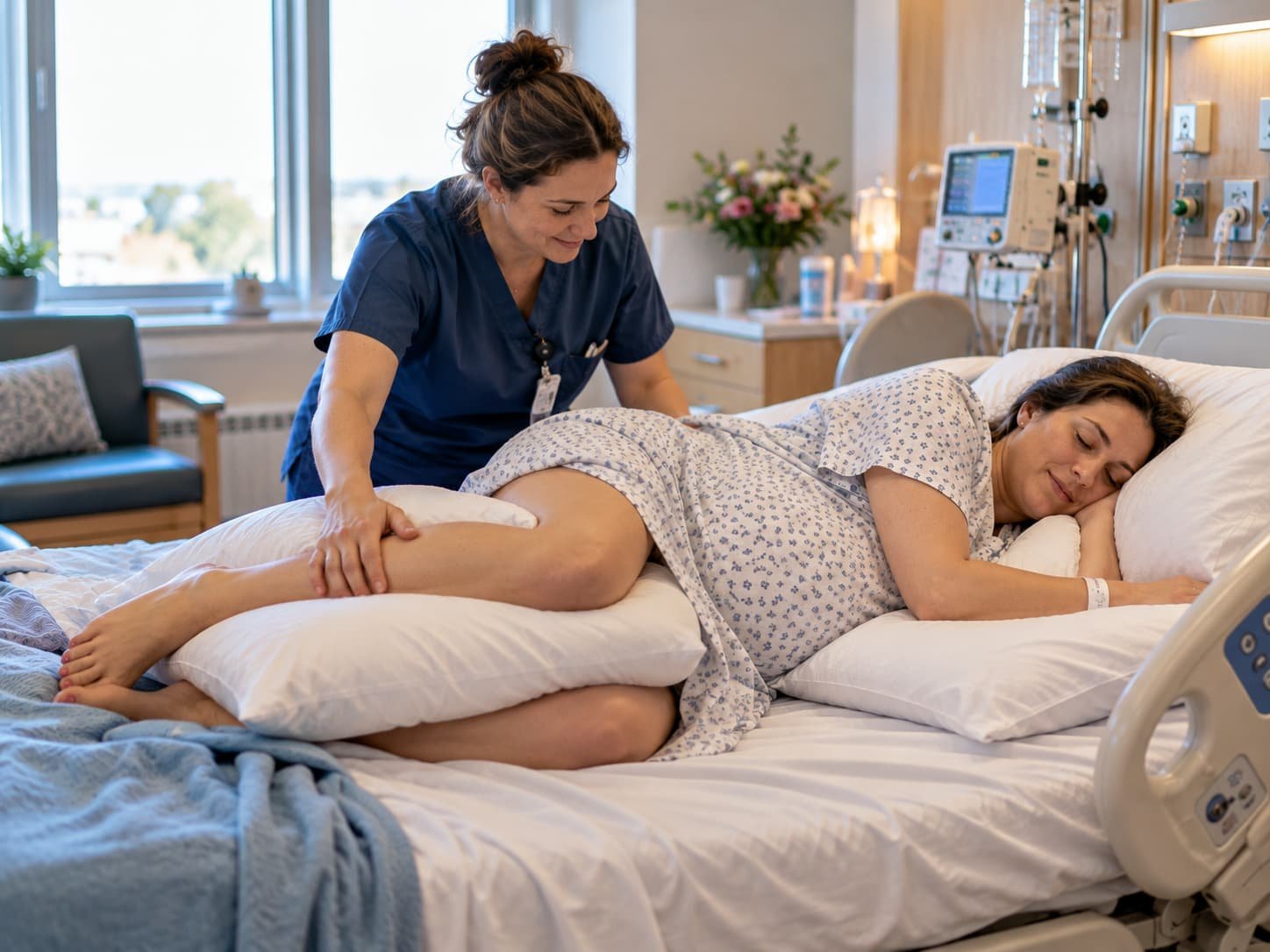
Side-lying can be particularly useful if you have an epidural because it allows you to rest while still changing the position of your pelvis.
You can lie on your left or right side with pillows supporting your upper leg, belly or back. Your midwife may help you adjust the position of your legs and hips depending on what is comfortable and what is happening with your baby.
One advantage of side-lying is that it does not require you to stand or support your body weight. This can be important if your legs feel heavy, numb or weak after the epidural.
You can also alternate from one side to the other if your maternity team recommends it. Regular position changes may help prevent you from staying in exactly the same position for a long period.
Side-lying positions have also been specifically studied in women with epidural anaesthesia. Evidence does not show that lying on your side is harmful, and some research suggests that supported recumbent positions may be a useful option during the later stages of labour.
Semi-Reclined Positions
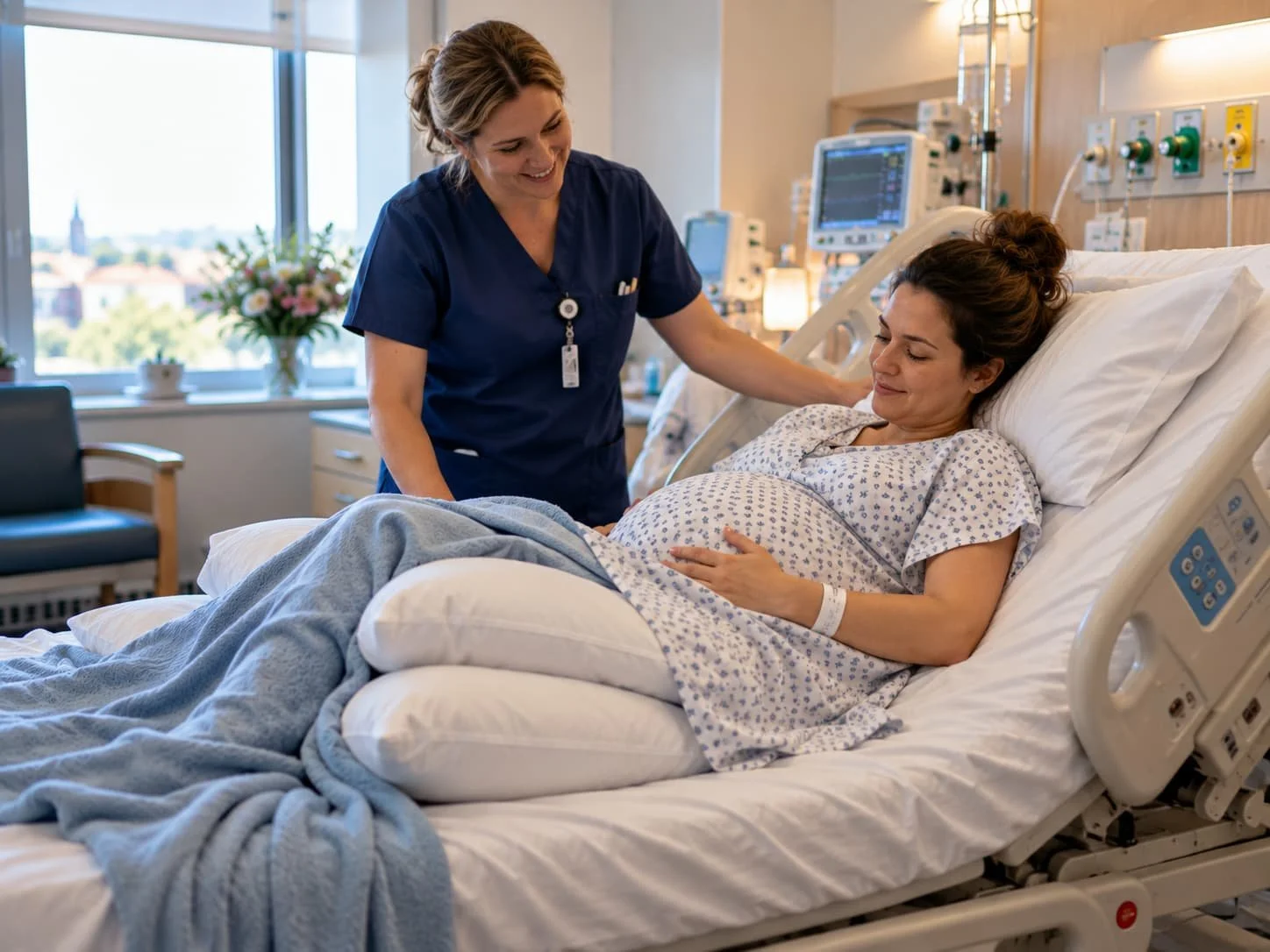
A semi-reclined position is another option that may work well with an epidural.
Instead of lying completely flat, you are supported at an angle, often with pillows or an adjustable hospital bed. Your upper body is raised while your legs are supported.
This can feel more comfortable than lying completely flat and may give you a better sense of space and movement.
Your maternity team can adjust the bed and your leg position according to what is happening during labour. You may also be able to lean slightly to one side rather than remaining directly on your back.
If you find lying flat uncomfortable, tell your midwife. You do not have to silently remain in a position that feels unpleasant simply because you have an epidural.
Supported Sitting
Depending on your level of sensation and leg strength, you may be able to sit in a supported position with an epidural.
You might sit upright in the bed with your back supported by pillows or the raised section of the bed. Your legs can be supported rather than carrying your full body weight.
This position can be useful if you want to feel more upright without standing.
Some women find sitting more comfortable during the earlier stages after an epidural because it gives them a different view of the room and allows them to interact more easily with their partner.
Your maternity team will need to make sure that your position is safe and that any monitoring, intravenous lines and epidural equipment remain secure.
Kneeling and Hands-and-Knees Positions
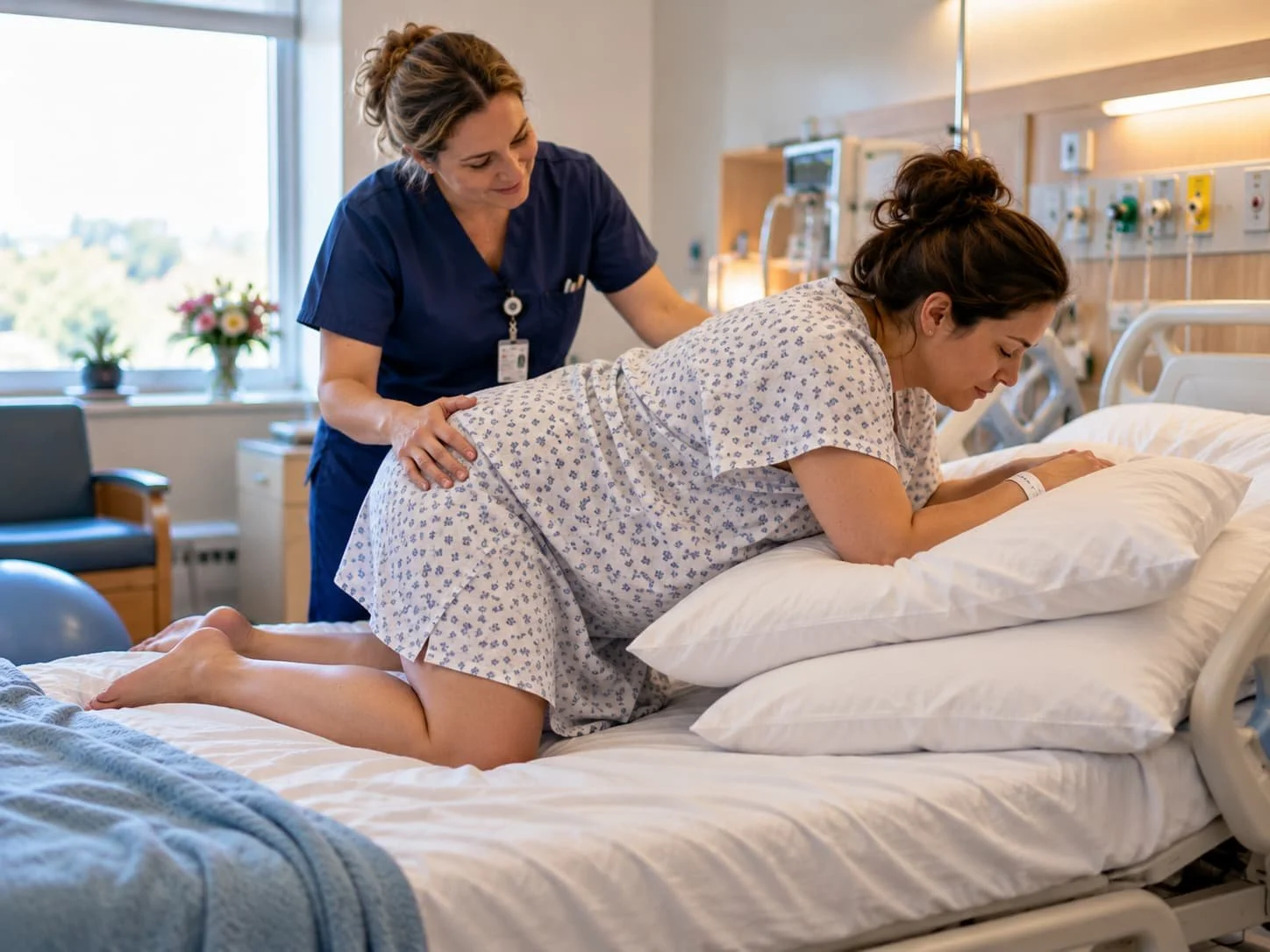
You may have heard about hands-and-knees positioning as a way to encourage movement and help with back discomfort during labour.
With an epidural, this position may or may not be possible.
If you have enough leg strength and sensation, and your maternity team considers it safe, you may be able to kneel or adopt a supported hands-and-knees position on the bed.
However, this should not be attempted independently if your legs are numb or weak. You may need several people to help you change position safely.
Hands-and-knees positioning can sometimes feel particularly comfortable when you are experiencing pressure in your back. Research has found that this position can reduce backache for some women, although evidence is less clear about whether it changes major birth outcomes.
The purpose does not have to be to "turn the baby". Sometimes a position is worth trying simply because it feels better.
Supported Kneeling Over the Head of the Bed
A variation of the hands-and-knees position involves kneeling on the bed while leaning forward over the raised head of the bed or several pillows.
This can give you the feeling of being forward and supported without requiring you to hold your entire body weight with your arms.
It may also give your partner or midwife an easier position from which to provide reassurance, massage or other comfort measures.
Whether this is possible will depend on your epidural, your strength and the equipment available in the birth room.
Never try to climb into this position without help if your legs have reduced sensation.
Standing With a Low-Dose or Mobile Epidural
Some women receive a low-dose epidural that allows more movement than a traditional epidural. This is sometimes described as a mobile or walking epidural.
The name can be slightly misleading because being able to move your legs does not automatically mean that you should walk independently.
If you have a mobile epidural, your maternity team will assess your strength, sensation and overall condition before deciding what movement is appropriate.
In some circumstances, you may be able to stand with assistance or lean against your partner or the bed.
Austrian guidance explains that epidural anaesthesia is a hospital procedure and that a range of birth positions may otherwise be available during labour.
If mobility is important to you, it is worth asking your chosen maternity unit in Vienna whether mobile epidural options are available and what their safety requirements are.
Can I Use a Birth Ball With an Epidural?
Possibly, but this depends heavily on your mobility and the specific epidural you receive.
If you have normal enough sensation and strength to sit safely, your maternity team may be able to help you use a birth ball or another supported seating option.
However, sitting on a ball requires balance and control. An epidural can affect both, so you should never get onto a birth ball alone after receiving an epidural unless your maternity team has specifically told you that it is safe.
Some women may instead use the ball while standing and leaning against it, or use it in another supported way before an epidural.
Ask your maternity team what equipment is available at your chosen birth setting in Vienna.
Changing Positions During the Pushing Stage
The pushing stage can feel very different with an epidural because you may have less sensation and may not feel the same urge to push.
Your maternity team can guide you through the process.
Depending on your situation, you may be able to use a side-lying, semi-reclined or other supported position. Your legs may need to be supported by pillows, your partner or members of the maternity team.
Some women worry that having an epidural means they have to give birth lying on their backs with their legs in stirrups.
That is not necessarily the case.
The evidence around birth positions with an epidural is complex, and studies have not established one universally best position. However, side-lying and other recumbent positions can be appropriate options, while lying completely flat on your back is generally not the only position to consider.
Your maternity team may recommend a particular position because of your baby's heart rate, your blood pressure, the baby's position or another clinical consideration. In that situation, safety takes priority over your original birth preference.
Why Side-to-Side Changes Can Be Helpful
If you have an epidural and need to remain in bed, changing sides can still give you some control over your labour.
You might spend some time on your left side and then change to your right side. Pillows can be used to support your legs, hips and abdomen.
Your midwife may also suggest particular positions depending on how your baby is positioned.
These changes can make a long period in bed feel less restrictive. They may also reduce discomfort caused by staying in exactly the same position.
You do not need to make constant changes. Sometimes staying comfortably on one side for a while and then switching when you feel ready is enough.
What If I Cannot Feel My Legs?
This is an important point.
If your legs feel very numb or heavy after an epidural, you should not attempt to stand, walk or get into a complicated position without assistance.
Tell your midwife exactly what you can and cannot feel.
Your maternity team can help you reposition safely and may use pillows, wedges or other supports to create a comfortable position without requiring you to bear your own weight.
There is no reason to feel disappointed if you cannot use the positions you imagined during pregnancy. The purpose of changing position is to support you and your baby, not to meet a particular birth plan checklist.
What If I Have Continuous Monitoring?
An epidural may be accompanied by monitoring of your baby's heart rate and your own vital signs. You may also have an intravenous line and the epidural equipment itself.
This can make movement feel more complicated, but it does not necessarily mean you cannot change positions.
Your midwife or doctor can help move the equipment with you when changing position. You may need assistance each time, particularly if your legs have reduced sensation.
Do not worry about asking for help.
A simple request such as "Can you help me turn onto my other side?" is completely reasonable.
Does an Epidural Mean I Have to Stay on My Back?
No.
An epidural may limit your mobility, but it does not automatically mean that you need to remain flat on your back throughout labour.
Side-lying, semi-reclined and supported positions may all be possible, depending on your individual circumstances.
In fact, Austrian guidance describes a range of possible birth positions, including lying, sitting, squatting and kneeling.
The position that is appropriate for you can change throughout labour.
You may start on your side, move into a more upright supported position and later return to your side when you become tired.
What If the Baby Is Not in the Ideal Position?
Your baby's position can influence which positions your maternity team recommends.
For example, if your baby is facing in a way that is associated with more back discomfort, your midwife may suggest certain changes in position.
Hands-and-knees and side-lying positions have been studied for babies in malpositions, although the evidence is not strong enough to say that a particular position will reliably turn a baby or improve the outcome.
This is an important distinction.
You can try a position because it feels comfortable or because your maternity team thinks it may be useful. But you should not feel that you have failed if your baby does not change position.
Birth is not something you can always control through positioning.
What Should I Discuss Before Getting an Epidural?
If you know that you may want an epidural, talk to your maternity team about your movement preferences before labour becomes intense.
You could ask whether the hospital supports position changes after an epidural, whether low-dose or mobile epidurals are available, whether you can use side-lying positions and whether supported sitting or kneeling may be possible.
You can also ask what happens if you have reduced sensation in your legs.
If you are giving birth in Vienna, these questions can be particularly useful during your hospital or maternity-unit planning. Policies and equipment can differ between settings, so asking your chosen birth team directly gives you the most useful information.
How Can Your Partner Help With Position Changes?
Your partner can be very useful when you have an epidural, particularly if you need help communicating what feels comfortable.
They can help you with pillows, hold your hand while you change position and remind you to relax your shoulders and jaw.
They can also tell your midwife if you seem uncomfortable or if you are struggling to move.
However, your partner should not try to lift or reposition you without guidance from the maternity team. An epidural can affect your balance and leg strength, so moving you incorrectly could result in a fall or injury.
The safest approach is to let the midwife guide the movement while your partner provides emotional and practical support.
How Can Mona Alkhelewi Support Your Birth Preferences?
Mona Alkhelewi is a birth and postpartum doula based in Vienna who supports women in German and English. Her prenatal preparation includes birth planning and partner preparation, helping women and their partners think through different possibilities before labour begins.
Her birth support can include movement, position changes, touch, acupressure, breathing and other comfort measures depending on what the birthing person wants at the time.
This can be particularly useful when your birth takes an unexpected direction. If you decide to have an epidural after initially hoping to avoid one, for example, a doula can help you continue thinking about comfort, movement and position changes within the limits of what your medical team considers safe.
A doula does not administer an epidural, advise you on medical treatment or replace your midwife or doctor. Her role is to provide emotional and physical support and help you feel heard and supported throughout the birth.
What If My Birth Plan Says I Do Not Want an Epidural?
It is perfectly reasonable to prepare for an unmedicated birth while remaining open to changing your mind.
Labour can be unpredictable. You may cope well for many hours and then decide that pain relief would help you rest and continue.
Choosing an epidural does not mean that your other preferences suddenly become irrelevant.
You can still ask to change positions when it is safe. You can still ask for a calm environment. You can still have your partner involved. You can still communicate what makes you feel comfortable.
A birth plan works best when it describes your preferences rather than becoming a set of rules that you must follow.
What If I Really Want to Move After My Epidural?
Tell your maternity team.
Explain that movement is important to you and ask what is possible with the epidural you have received.
Your midwife can assess your mobility and suggest safe alternatives. You may discover that you can change sides, sit supported, lean forward or use another position that you had not considered.
Even small changes can make a difference to how you experience labour.
The important thing is to work with your care team rather than trying to move independently when your legs are numb.
Frequently Asked Questions
-
Yes, position changes may still be possible, but your options depend on the strength of the epidural, your leg sensation and strength, monitoring and your overall medical situation. Side-lying and supported positions are commonly useful options.
-
Often, yes. You may be able to sit in a supported or semi-reclined position in the bed. Your midwife can help you find a position that is comfortable and safe.
-
Some women with a low-dose or mobile epidural may have enough sensation and strength to stand or move with assistance. This is not suitable for everyone, and you should never walk independently after an epidural unless your maternity team has confirmed that it is safe.
-
There is no single best position for every woman. Side-lying, semi-reclined and other supported positions may be appropriate. Your baby's position, your mobility and how labour is progressing will influence what works best for you.
-
Sometimes. If you have sufficient leg strength and sensation, your maternity team may help you into a supported hands-and-knees position. If your legs are numb or weak, you should not attempt this independently.
-
Possibly, depending on your mobility and the type of epidural. Because an epidural can affect balance and leg strength, you should only use a birth ball with appropriate support and approval from your maternity team.
-
No. An epidural may limit your mobility, but it does not automatically mean you must remain flat on your back. Side-lying, semi-reclined and other supported positions may be available depending on your circumstances.
-
Certain positions may feel more comfortable and may be suggested by your midwife depending on your baby's position. However, evidence does not show that one particular position can reliably turn a baby or guarantee a particular birth outcome.
-
Your partner can provide support, but your maternity team should guide the actual movement if your legs are affected by the epidural. This reduces the risk of falling or injury.
-
Yes. If movement and position changes are important to you, discuss them with your maternity team during pregnancy or early labour. If you are planning to give birth in Vienna, you can also ask your chosen maternity unit what types of movement and positioning are possible after an epidural.
Final Thoughts
Having an epidural does not necessarily mean giving up all movement or all choice about your position during labour.
Your options may be more limited than they would be without an epidural, particularly if your legs feel heavy or numb. But with appropriate support, you may still be able to change sides, sit in a supported position, use pillows to adjust your body, lean forward or try other positions that are safe for your particular situation.
The most useful approach is to remain flexible.
You can have a preference for side-lying, movement or an upright position while understanding that your maternity team may recommend something different if there is a medical reason.
If you are preparing for birth in Vienna, talk to your chosen maternity team about epidural options and mobility before labour begins. Knowing what is possible can make it easier to make informed decisions when the time comes.
And remember that choosing an epidural does not mean you have failed to follow your birth plan. Your goal is not to give birth in one particular position or without a particular type of pain relief. Your goal is to feel informed, supported and as comfortable and safe as possible while bringing your baby into the world.
Medical disclaimer: This article is intended for general educational purposes and does not replace individual medical advice. Epidural anaesthesia and mobility during labour should always be discussed with your midwife, doctor or anaesthesia team. The positions available to you will depend on your individual circumstances, the type and dose of epidural, your baby's wellbeing and the policies and facilities of your chosen maternity setting.
Sources Used
Austrian Public Health Portal, "Birth: Supportive Measures and Pain Relief."
Cochrane, "Maternal position in the second stage of labour for women with epidural anaesthesia."
NICE evidence review, "Position for birth."
Cochrane, "Mothers' positions in labour when baby is lying back-to-back."
Cochrane, "Hands and knees posture in late pregnancy or labour for fetal malposition."
Clinical evidence reviews concerning maternal positioning during labour with epidural anaesthesia.
Mona Alkhelewi, "Birth & Postpartum Doula Services in Vienna."